Caprese
The story
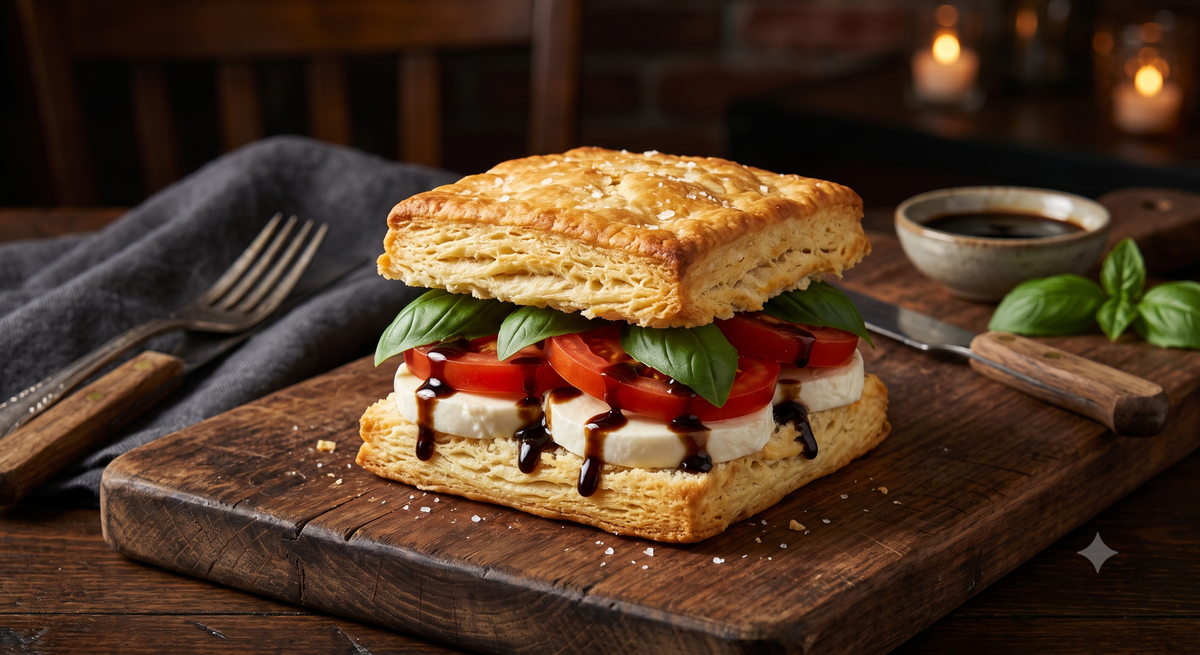
Caprese is three ingredients and a rule, and the rule is that all three have to be good. There is no technique to compensate with. A pale winter tomato ruins it, rubbery mozzarella ruins it, dried basil ruins it. Get all three right, add grilled chicken and a balsamic reduction, put it on a District Biscuit, and you have a lunch that feels like a Tuesday in Capri rather than a Tuesday in an office.
The specific challenge is water. Fresh mozzarella weeps, ripe tomatoes weep more, and between them they will destroy any bread that is not built for it within about five minutes. Two things solve it. Salt the tomatoes and drain them first, which pulls out most of the liquid before assembly. Then use a base whose crisp buttery edges resist the rest. The District Biscuit's laminated layers absorb the balsamic and the last of the tomato juice as flavor while the perimeter stays intact.
That is the culinary canvas at its most seasonal. Make it in August with a tomato from a farm stand and it is one of the best things in the Studio. Make it in February and it is fine. That is the deal with Caprese and it always has been.
Why you'll love it
- Twenty minutes, no sauce to make, and a shopping list of six real ingredients.
- Salting the tomatoes first is the small step that keeps the whole build from going wet.
- The District Biscuit resists mozzarella and tomato water where ciabatta gives up.
- Excellent at room temperature, which makes it a genuine packed-lunch build.
- Works meat-free by simply removing the chicken, with nothing else to adjust.
Ingredients
- 4 District Biscuits, warmed and split
- 1.25 lb boneless skinless chicken breast, sliced into cutlets
- 2 large ripe tomatoes, sliced 1/4 inch thick
- 12 oz fresh mozzarella, sliced
- 1 cup fresh basil leaves
- 1/2 cup balsamic vinegar
- 1 tbsp honey
- 3 tbsp extra virgin olive oil, divided
- 1 tsp kosher salt for the tomatoes
- Flaky salt and coarsely cracked black pepper
How to build it
-
1
Lay the tomato slices on a paper towel in a single layer, sprinkle them with the kosher salt, and leave them 15 minutes while you cook everything else.
-
2
Simmer the balsamic vinegar and honey in a small saucepan over medium heat for 6 to 8 minutes until it reduces by half and coats a spoon.
-
3
Pat the chicken cutlets dry, season them with salt and pepper, and rub them with 1 tbsp of the olive oil.
-
4
Sear the cutlets in a hot skillet or grill pan for 4 minutes per side until golden with visible marks, then rest them 5 minutes.
-
5
Warm the District Biscuits in a 350F oven for 5 minutes and split them so the flaky layers are open.
-
6
Blot the salted tomato slices dry with a fresh paper towel, which removes the liquid that would otherwise ruin the sandwich.
-
7
Drizzle the remaining olive oil onto both biscuit faces, then layer sliced chicken, mozzarella, blotted tomato, and a thick handful of basil leaves.
-
8
Drizzle the balsamic reduction over the top, finish with flaky salt and cracked pepper, cap, and serve immediately or at room temperature.
Pro tips & swaps
- Salt and blot the tomatoes. Fifteen minutes and a paper towel is the difference between this build and a wet one.
- Reduce the balsamic yourself. Bottled glaze is mostly sugar and tastes flat next to a real reduction.
- Tear the basil rather than chopping it. A knife bruises the leaves and turns the cut edges black within minutes.
- Let the chicken rest and go on slightly warm, not hot. Hot chicken melts fresh mozzarella into a puddle.
- Drop the chicken entirely for a classic vegetarian Caprese, which needs no other adjustment.
Put this on your menu
District Biscuit ships frozen, 60 biscuits to a case, and bakes from frozen in 22 to 24 minutes. Order it through US Foods, Baldor, Omaha Beef Co., MDI or Saval Foodservice.
Frequently asked questions
Can I make the Caprese Biscuit ahead of time?
The balsamic reduction keeps a month and the chicken can be cooked 3 days ahead. Slice the tomatoes and mozzarella and assemble within about an hour of eating, since fresh mozzarella and cut tomato both release water over time.
What's the best biscuit to use for a Caprese sandwich?
A flaky biscuit with crisp edges, like a District Biscuit, is ideal because fresh mozzarella and ripe tomato are both very wet. Ciabatta and focaccia both saturate, while the District Biscuit's buttery layers hold their structure.
Can I substitute the chicken in this recipe?
Yes. Grilled shrimp, prosciutto, or nothing at all all work. Removing the chicken gives you the classic vegetarian Caprese with no other changes needed.
Is there a gluten-free or vegetarian version of the Caprese Biscuit?
Vegetarian is as simple as leaving the chicken out. The District Biscuit is wheat-based, so check with the District Biscuit cafe about gluten-free options. Every other component is naturally gluten-free.
How do I keep the sandwich from going soggy?
Salt the tomato slices for 15 minutes and blot them dry before they go anywhere near the biscuit. That single step removes most of the water. Assembling within an hour of eating handles the rest.
What should I serve or drink with a Caprese Biscuit?
Marinated olives, a simple arugula salad, or grilled zucchini. For drinks, a Pinot Grigio, a Vermentino, or sparkling water with lemon.
How many calories are in a Caprese Biscuit?
A single build lands roughly in the 580 to 700 calorie range, driven mostly by the fresh mozzarella. Cutting the mozzarella to 8 oz total brings it near 480.
How do I store and reheat leftovers?
This build does not store assembled. Keep the components separate for up to 3 days and build fresh. It is meant to be eaten at room temperature, so no reheating is required beyond warming the District Biscuit at 350F.
What makes a District Biscuit different from a regular biscuit?
District Biscuits are made with crisp, buttery edges and distinct flaky layers engineered to be a legit sandwich base, not just a side. That structure is why they hold up against mozzarella and tomato water where ciabatta saturates. It is your culinary canvas, built to carry big flavor from first bite to last.