Bolognese Biscuit Bake
The story
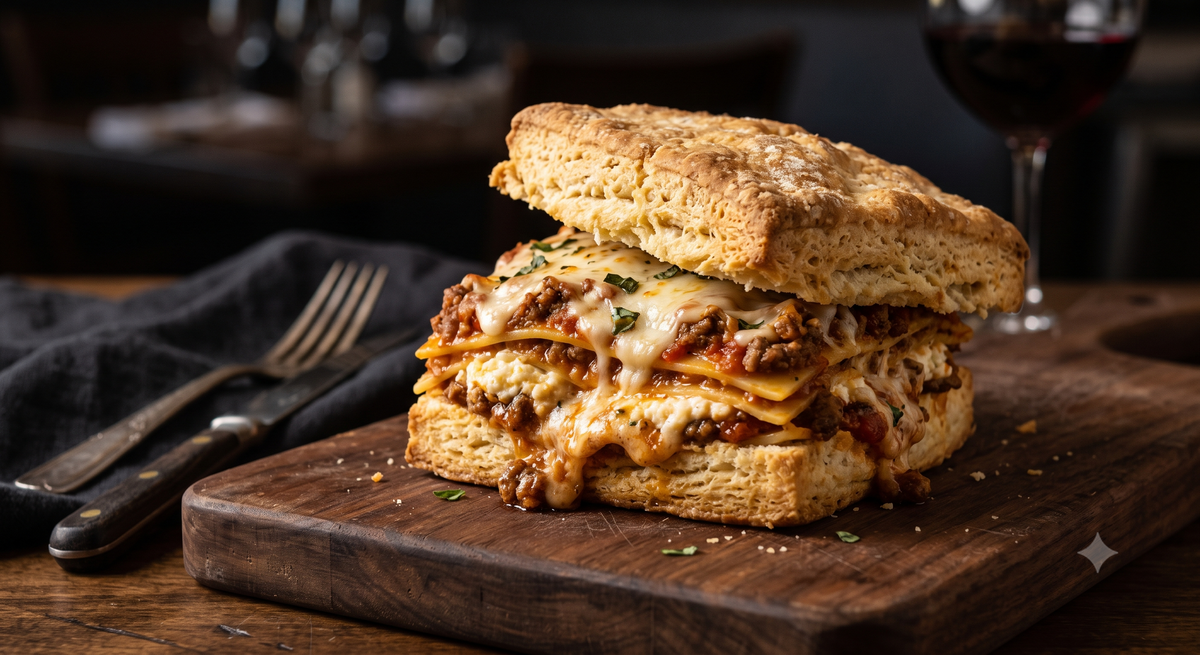
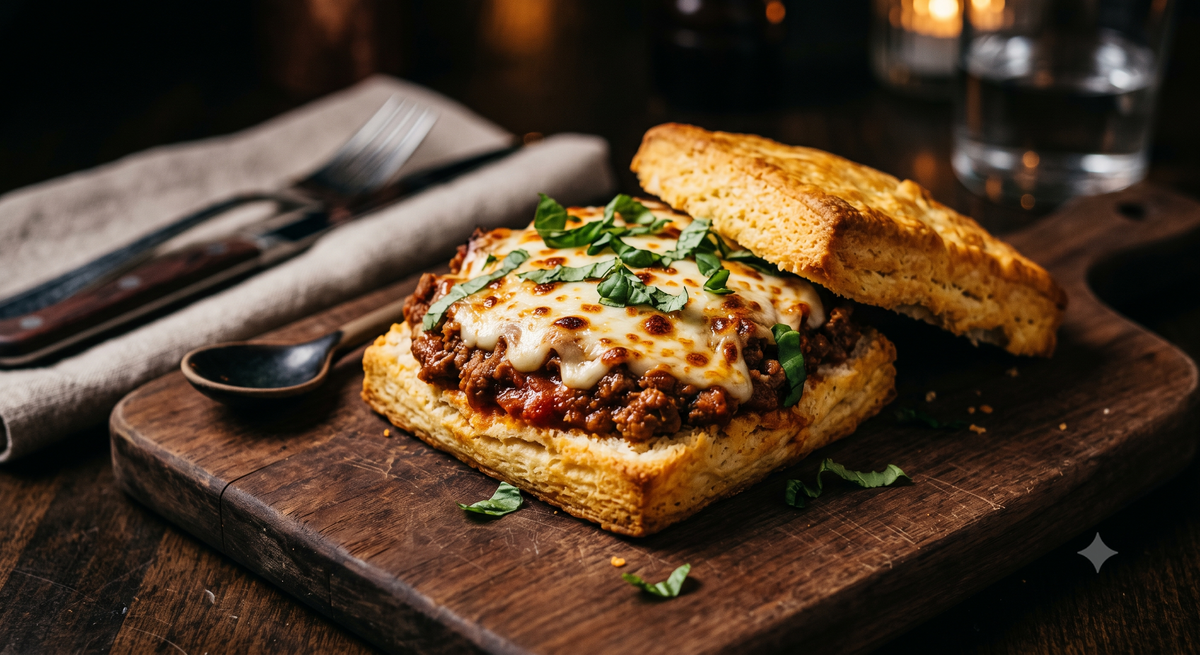
This is the inverse of the lasagna. Instead of biscuits between layers, the biscuits go on top, split and arranged like a cobbler crust over a bolognese that has been simmering long enough to go dark and glossy. What comes out of the oven has a golden lid with crisp peaks, and underneath it a ragu that has been steaming into the biscuit undersides for half an hour.
That contrast is the whole design. The tops stay dry and crisp because they are exposed to direct oven heat, while the undersides go soft and saturated with sauce. One biscuit, two completely different textures, which is something a pastry crust cannot do and a pasta layer certainly cannot. The milk in the bolognese matters too, since it tenderizes the beef over the long simmer and gives the sauce a rounder, less acidic finish that suits a buttery topping.
That is the culinary canvas as a pot pie without the pastry work. Seventy minutes, mostly unattended, and a pan that looks like it took considerably more effort than it did.
Why you'll love it
- One biscuit gives you a crisp top and a sauce-soaked bottom in the same bite.
- No pastry work, no rolling, no chilling dough. Split biscuits and arrange them.
- Milk in the bolognese tenderizes the beef and softens the acidity over the long simmer.
- Mostly unattended, so seventy minutes is really about twenty minutes of work.
- Looks like a serious project and is not one.
Ingredients
- 6 District Biscuits, split into 12 halves
- 1.5 lb ground beef, 85 percent lean
- 4 oz pancetta, diced small
- 1 onion, 2 carrots, and 2 celery stalks, diced very fine
- 4 cloves garlic and 3 tbsp tomato paste
- 1 can crushed tomatoes, 28 oz
- 3/4 cup whole milk and 1/2 cup dry white wine
- 1 cup grated parmesan, divided
- 2 tbsp olive oil, 1 tsp nutmeg, and 2 bay leaves
- 2 tbsp melted butter, fresh basil, salt, and black pepper
How to build it
-
1
Render the pancetta in the olive oil over medium heat for 6 minutes until it crisps and gives up its fat.
-
2
Add the finely diced onion, carrot, and celery and cook 10 minutes until completely soft and lightly golden.
-
3
Add the ground beef, break it up, and brown it for 8 minutes, letting it sit undisturbed in patches to develop color.
-
4
Stir in the garlic and tomato paste, cook 2 minutes, then pour in the white wine and reduce it almost completely.
-
5
Add the milk and simmer 5 minutes until it is nearly absorbed, which is the step that tenderizes the beef and rounds out the sauce.
-
6
Add the crushed tomatoes, nutmeg, bay leaves, and 2 tsp salt, then simmer uncovered for 25 minutes until thick and glossy, and stir in half the parmesan.
-
7
Heat the oven to 400F, pour the bolognese into a deep 9 by 13 pan, and arrange the split biscuit halves cut-side down across the surface, overlapping slightly like a cobbler.
-
8
Brush the biscuit tops with melted butter, scatter the remaining parmesan, bake 25 minutes until the tops are deep golden, rest 10 minutes, and serve with torn basil.
Pro tips & swaps
- Dice the vegetables very fine. In a bolognese they are meant to disappear into the sauce, not show up as chunks.
- The milk step is not optional and it is not weird. It is traditional, and it is what makes a bolognese taste rounder than a marinara with meat in it.
- Biscuit halves cut-side down. The cut face takes the steam from the sauce while the crust side stays exposed and crisps.
- Brush the tops with butter before baking. It is the difference between golden and pale.
- Overlap the biscuits slightly rather than leaving gaps. Gaps let the sauce bubble up and steam the tops from above.
Bring District Biscuits to your business
Put our golden, flaky biscuits to work on your own menu — cater your next event, or bring District Biscuits to your restaurant, hotel, or grocery program.
Frequently asked questions
Can I make the Beef Bolognese Biscuit Bake ahead of time?
The bolognese can be made up to 4 days ahead or frozen for 3 months, and it improves with time. Add the biscuit topping and bake only when you are ready to serve, since the crisp top does not survive storage.
What's the best biscuit to use for a cobbler-style topping?
A flaky, laminated biscuit like a District Biscuit is ideal because it gives you a crisp exposed top and a sauce-soaked underside simultaneously. A pastry crust stays uniformly crisp and a pasta layer stays uniformly soft.
Can I substitute the beef in this recipe?
Yes. Ground pork, veal, or a mix of all three is traditional. Ground turkey works for a lighter version, though you may want to add an extra tablespoon of olive oil. **Is there a gluten-free or vegetarian version of the Beef Bolognese Biscuit Bake?** See the Lentil Bolognese Biscuit Bake for the meat-free version, which uses the same method. The District Biscuit is wheat-based, so check with the District Biscuit cafe about gluten-free options.
Why are my biscuit tops pale and soft?
Either the oven was too cool or the biscuits were left with gaps between them. Bake at a full 400F, overlap the halves so steam cannot escape upward between them, and brush the tops with butter before they go in.
What should I serve or drink with the Beef Bolognese Biscuit Bake?
A sharp green salad is really all it needs. For drinks, a Sangiovese, a Barbera, or any medium-bodied Italian red.
How many calories are in a serving of the Beef Bolognese Biscuit Bake?
One of six servings lands roughly in the 620 to 740 calorie range, driven by the beef, pancetta, and parmesan. Dropping the pancetta and using ground turkey brings it near 510.
How do I store and reheat leftovers?
Store covered for up to 4 days. Reheat at 375F for 20 minutes uncovered to bring the biscuit tops back, never in a microwave, which will make the topping soft and pale.
What makes a District Biscuit different from a regular biscuit?
District Biscuits are made with crisp, buttery edges and distinct flaky layers engineered to be a legit sandwich base, not just a side. As a cobbler topping, that structure gives you crisp above and saturated below in the same piece. It is your culinary canvas, built to carry big flavor from first bite to last.