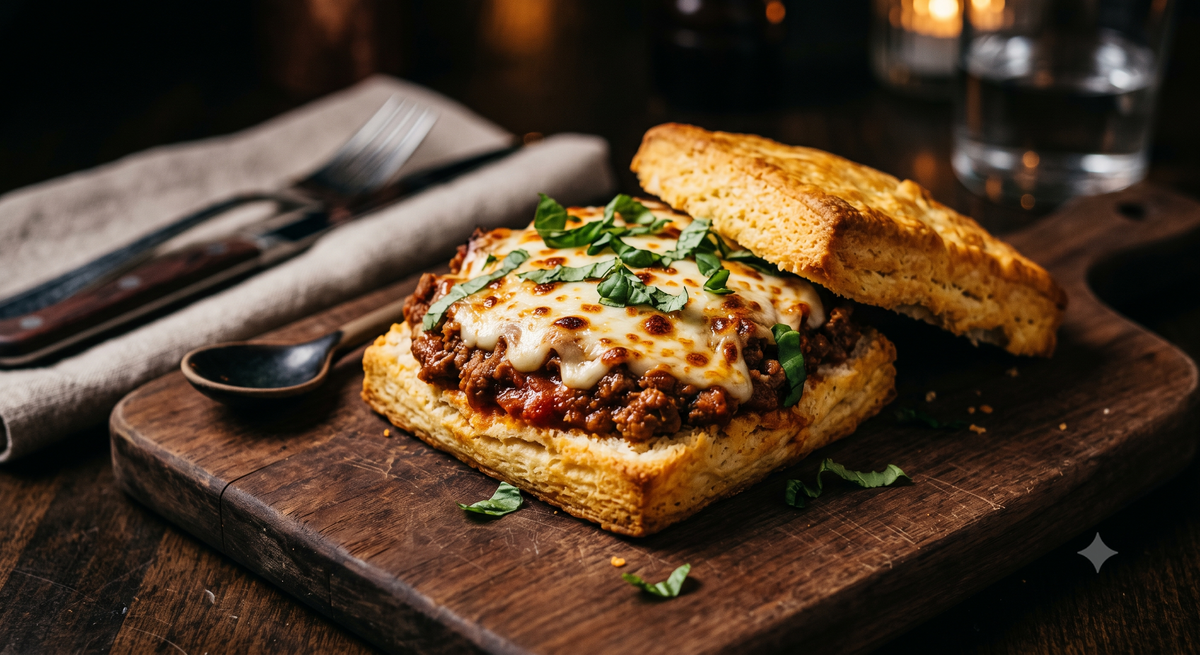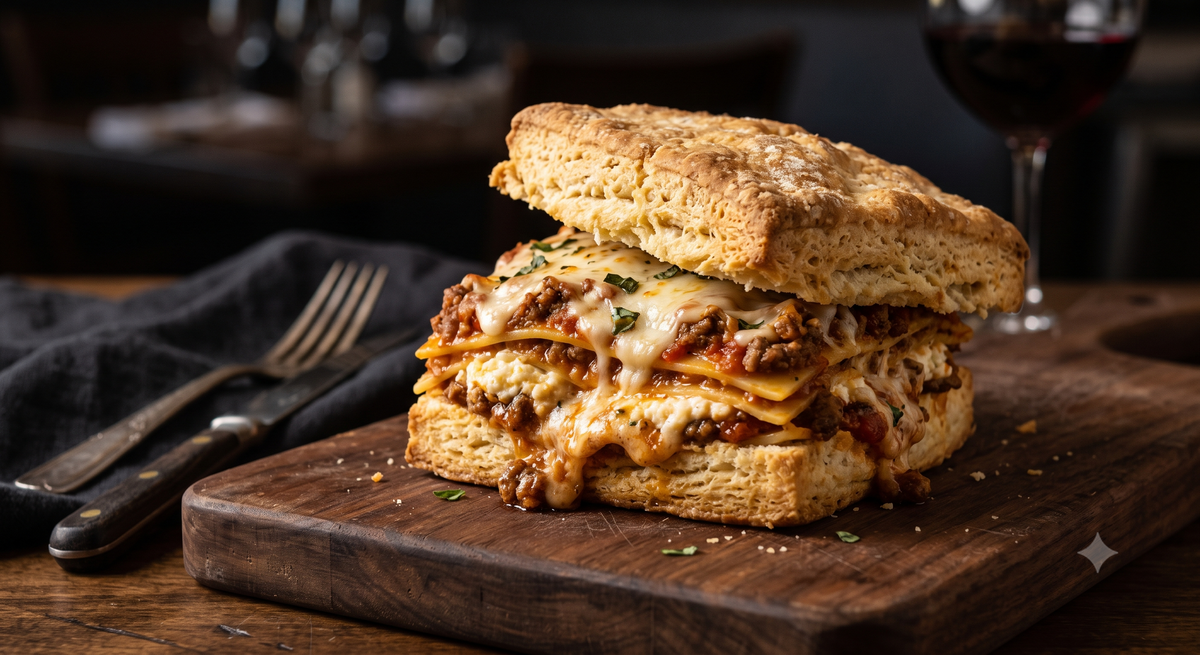
Beef Biscuit Lasagna
The story
Lasagna noodles are a delivery system. They have essentially no flavor of their own, they need to be boiled or soaked, and their entire contribution is holding sauce in horizontal planes. Split District Biscuits do the same job and bring butter, salt, and a laminated crumb, which means the structural layer is finally doing something besides existing.
The trade-off is that biscuits absorb faster than pasta, so the sauce needs to be thicker than a standard marinara or the whole pan goes wet. That is why this ragu simmers uncovered for a full thirty minutes with a little tomato paste and no added water. Get the sauce right and the layers hold. Cut-side down against the sauce, crust side up against the cheese, and the pan cuts into squares that stand on a plate instead of sliding into a heap.
That is the culinary canvas as Sunday dinner. Eighty minutes, feeds eight, and better on day two. It is also the build that converts skeptics, because everyone thinks they know what lasagna tastes like right up until the layer between the ragu is buttery.
Why you'll love it
- The structural layer finally contributes flavor instead of just holding sauce.
- No boiling noodles, no soaking sheets, no draining anything.
- A properly reduced ragu means the layers hold and the squares cut clean.
- Feeds eight from one pan and is better reheated on day two.
- Freezes in portions for three months, which makes it real meal prep.
Ingredients
- 8 District Biscuits, split into 16 halves
- 2 lb ground beef, 85 percent lean
- 1 onion, 2 carrots, and 2 celery stalks, all diced fine
- 4 cloves garlic and 3 tbsp tomato paste
- 2 cans crushed tomatoes, 28 oz each
- 1/2 cup dry red wine
- 15 oz whole milk ricotta beaten with 1 egg
- 16 oz low-moisture mozzarella, shredded
- 1 cup grated parmesan, 2 tsp oregano, and 1 tsp red pepper flakes
- 2 tbsp olive oil, fresh basil, salt, and black pepper
How to build it
-
1
Heat the olive oil in a large pot and cook the diced onion, carrot, and celery for 10 minutes until soft and beginning to color.
-
2
Add the ground beef, break it up, and brown it hard for 8 minutes, letting it sit undisturbed in patches so it develops real color.
-
3
Stir in the garlic, tomato paste, oregano, and red pepper flakes and cook 2 minutes until the paste darkens.
-
4
Pour in the red wine, reduce it by half, then add the crushed tomatoes and 2 tsp salt.
-
5
Simmer uncovered for 30 minutes until the ragu is thick enough that a spoon dragged through it leaves a clear channel, which is the consistency the biscuit layers require.
-
6
Heat the oven to 375F, spread a thin layer of ragu in a 9 by 13 pan, and tile 5 split biscuit halves cut-side down across the bottom.
-
7
Layer a third of the ricotta mixture, a third of the remaining ragu, and a third of the mozzarella, then repeat the biscuit and filling sequence twice more.
-
8
Finish with parmesan edge to edge, bake covered for 30 minutes, uncover for 15 more until browned and bubbling, then rest 15 minutes before cutting.
Pro tips & swaps
- The 30-minute uncovered simmer is the whole recipe. A loose ragu produces a wet pan and layers that will not cut.
- Biscuit halves cut-side down against the sauce. The cut face absorbs and the crust side holds.
- Beat an egg into the ricotta. It sets during the bake and stops the ricotta layer from sliding out when you cut.
- Use low-moisture mozzarella, not fresh. Fresh mozzarella releases water and this pan cannot absorb any more.
- The 15-minute rest is mandatory. Cut it hot and eight servings become one large pile.
Bring District Biscuits to your business
Put our golden, flaky biscuits to work on your own menu — cater your next event, or bring District Biscuits to your restaurant, hotel, or grocery program.
Frequently asked questions
Can I make Beef Biscuit Lasagna ahead of time?
Yes, and you should. Assemble fully up to 2 days ahead and bake when needed, adding 10 minutes from cold. Baked, it keeps 4 days and is genuinely better on day two. It also freezes for 3 months.
What's the best biscuit to use for lasagna layers?
A flaky, laminated biscuit like a District Biscuit is ideal because it survives a long bake while absorbing sauce. Softer biscuits dissolve into the layers, and pasta sheets contribute no flavor of their own.
Can I substitute the beef in this recipe?
Yes. Ground turkey, ground pork, or a mix of beef and pork all work. Italian sausage removed from its casing is excellent and means you can skip most of the seasoning.
Is there a gluten-free or vegetarian version of Beef Biscuit Lasagna?
See the Vegan Biscuit Lasagna or Lentil Bolognese Biscuit Bake for meat-free versions. The District Biscuit is wheat-based, so check with the District Biscuit cafe about gluten-free options.
Why is my biscuit lasagna watery?
The ragu was not reduced enough, or you used fresh mozzarella. Simmer uncovered until a spoon leaves a clear channel, and use low-moisture shredded mozzarella. Biscuits absorb faster than pasta, so the sauce must be thicker than you would make for a traditional lasagna.
What should I serve or drink with Beef Biscuit Lasagna?
A sharp arugula salad with lemon, or garlic broccolini. For drinks, Chianti, Montepulciano, or Nero d'Avola.
How many calories are in a serving of Beef Biscuit Lasagna?
One of eight servings lands roughly in the 620 to 750 calorie range, driven by the beef, ricotta, and mozzarella. Using ground turkey and cutting the mozzarella to 12 oz brings it near 520.
How do I store and reheat leftovers?
Store covered for up to 4 days or freeze portions for 3 months. Reheat at 350F for 20 minutes covered, or 40 from frozen. Biscuit layers do not go gummy on reheat the way pasta sheets do.
What makes a District Biscuit different from a regular biscuit?
District Biscuits are made with crisp, buttery edges and distinct flaky layers engineered to be a legit sandwich base, not just a side. In a layered bake, that laminated structure is what lets the pan cut into clean squares. It is your culinary canvas, built to carry big flavor from first bite to last.