Kimchi Fried Rice Biscuit
The story
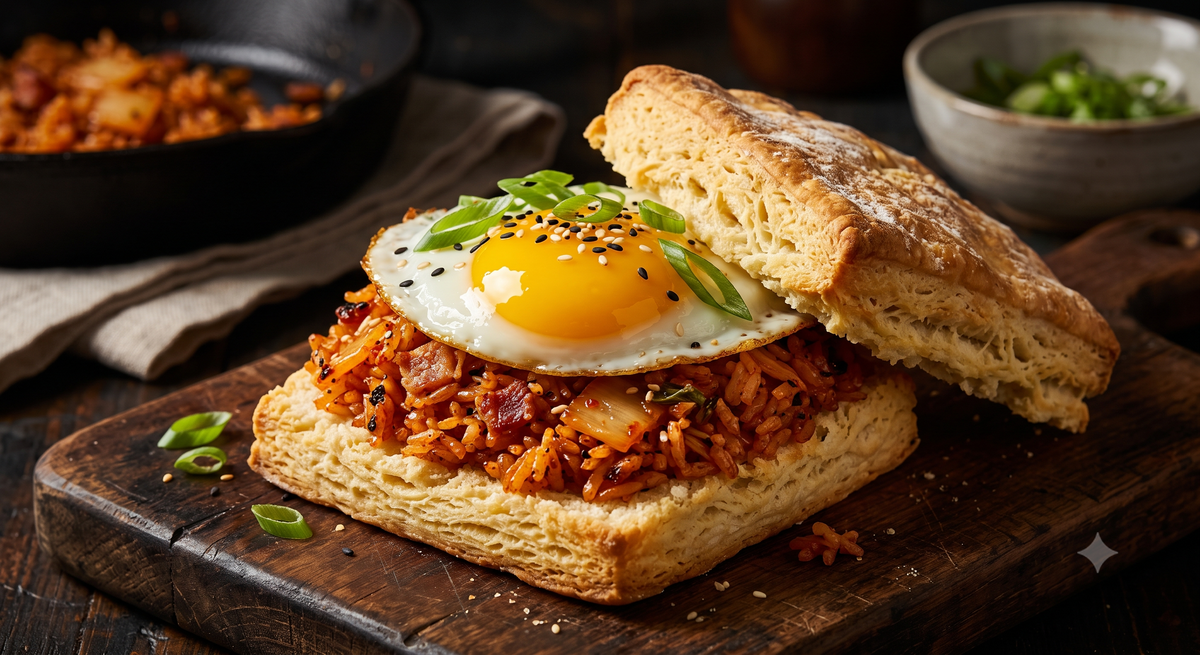
This is not the Bulgogi Biscuit with rice added. The hero here is the rice itself, pressed into a hot pan and left alone until the bottom layer turns into a crackling golden sheet, the way it does in a stone bowl. Kimchi, gochujang butter, scallion, and a fried egg on top, all of it sitting on a griddled District Biscuit that has been split and pressed cut-side down into butter.
Two crisp surfaces stacked is an unusual thing to build deliberately. The griddled biscuit face gives you a flat, cracker-like plane, and the crisped rice gives you a shattering crust on top of it. In between, soft rice and melted kimchi butter. When you cut through it, you get crunch, give, crunch, and then a runny yolk running down through all three. Nothing else on this menu does that.
That is the culinary canvas doing something structural rather than something clever. Day-old rice, a jar of kimchi, and a biscuit, producing a texture stack that no single component could manage alone.
Why you'll love it
- Two separate crisp layers, which is a texture nobody else on this menu is doing.
- Uses day-old rice and a jar of kimchi, both of which are already in most fridges.
- Gochujang butter melts through everything and takes about forty seconds to make.
- Distinct from the Bulgogi Biscuit rather than a variation on it.
- Works equally well as a dinner or a very good hungover brunch.
Ingredients
- 4 District Biscuits, split into 8 halves
- 4 cups cooked short-grain rice, cold and at least a day old
- 1.5 cups kimchi, chopped, plus 1/4 cup of its brine
- 4 tbsp butter, divided, plus 1 tbsp gochujang
- 8 oz ground pork or diced bacon
- 4 large eggs
- 4 scallions, sliced thin, whites and greens separated
- 3 cloves garlic, minced, and 1 tbsp soy sauce
- 1 tbsp toasted sesame oil and 2 tbsp neutral oil
- Toasted sesame seeds and crumbled nori to finish
How to build it
-
1
Mash 2 tbsp of the butter with the gochujang into a compound butter and set it aside.
-
2
Break the cold rice apart with your hands so no clumps remain, which is the step that determines whether it fries or steams.
-
3
Brown the ground pork or bacon in the neutral oil over medium-high heat for 6 minutes until crisp, then add the garlic and scallion whites for 1 minute.
-
4
Add the chopped kimchi and cook 3 minutes until it darkens and its liquid cooks off, then stir in the kimchi brine and soy sauce.
-
5
Add the rice and the gochujang butter, tossing until every grain is coated and evenly colored.
-
6
Now press the rice flat into the pan with a spatula and leave it completely alone for 5 minutes, which builds the crisp bottom crust.
-
7
Melt the remaining butter in a second pan and griddle the split biscuit halves cut-side down for 3 minutes until flat and golden, then fry the eggs covered for 3 minutes.
-
8
Set two griddled biscuit halves on each plate, scoop the rice on crisp-side up, slide an egg on top, then finish with sesame oil, scallion greens, sesame seeds, and nori.
Pro tips & swaps
- Day-old rice only. Fresh rice has too much surface moisture and will steam into a sticky mass no matter how hot the pan is.
- Break every clump apart before the rice hits the pan. Clumps stay soft in the middle and never crisp.
- The five undisturbed minutes at the end are the whole point. Stirring during that window costs you the crust.
- Use the kimchi brine, do not pour it out. It carries most of the acidity and funk.
- No pork? Diced firm tofu browned hard, or nothing at all, both work. Kimchi carries the dish on its own.
Bring District Biscuits to your business
Put our golden, flaky biscuits to work on your own menu — cater your next event, or bring District Biscuits to your restaurant, hotel, or grocery program.
Frequently asked questions
Can I make the Kimchi Fried Rice Biscuit ahead of time?
Cook the rice a day or more ahead, which the recipe requires anyway. The pork and kimchi base can be made 3 days ahead. The frying, griddling, and egg all happen to order, since every one of them is about texture.
What's the best biscuit to use under fried rice?
A flaky biscuit with crisp edges, like a District Biscuit, is ideal because griddling the cut face gives you a flat, cracker-like plane that supports the rice. A soft base collapses and gives you one uniform texture.
Can I substitute the pork in this recipe?
Yes. Bacon, spam, ground beef, or browned firm tofu all work. The dish is also completely fine with no protein at all beyond the egg, since the kimchi carries it. **Is there a gluten-free or vegetarian version of the Kimchi Fried Rice Biscuit?** Vegetarian works with tofu or no meat, but check that your kimchi contains no fish sauce or shrimp paste. Use tamari for gluten-free, and note the District Biscuit is wheat-based, so check with the District Biscuit cafe about options.
Why is my fried rice sticky instead of crisp?
Fresh rice, clumps left intact, or a pan that was not hot enough. Use rice at least a day old, break every clump by hand, use your widest pan, and leave it undisturbed for the final five minutes.
What should I serve or drink with the Kimchi Fried Rice Biscuit?
Quick-pickled cucumber, steamed greens, or more kimchi. For drinks, a cold lager, a soju highball, or barley tea.
How many calories are in the Kimchi Fried Rice Biscuit?
A single build lands roughly in the 640 to 780 calorie range, driven by the rice, butter, and pork. Skipping the pork and cutting the butter to 2 tbsp brings it near 520.
How do I store and reheat leftovers?
Store the fried rice for up to 3 days. Reheat it in a hot dry skillet to bring the crisp back, never a microwave. Griddle fresh biscuit halves and fry a fresh egg, both of which take about three minutes.
What makes a District Biscuit different from a regular biscuit?
District Biscuits are made with crisp, buttery edges and distinct flaky layers engineered to be a legit sandwich base, not just a side. Griddled cut-side down, that structure gives you a second crisp plane under the rice crust. It is your culinary canvas, built to carry big flavor from first bite to last.